

Note: I am a participant in the Amazon Associate program which means I earn from qualifying purchases. Some links in this email are affiliate links, which means I may earn a small commission if you purchase through them, at no additional cost to you. 💛
Hey yall!
If you’ve ever wanted to transform your art show into something a little more immersive… something that allows your guests to step into the artwork instead of just walk past it… this one’s for you. Having an interactive element will just take your art show to the next level.
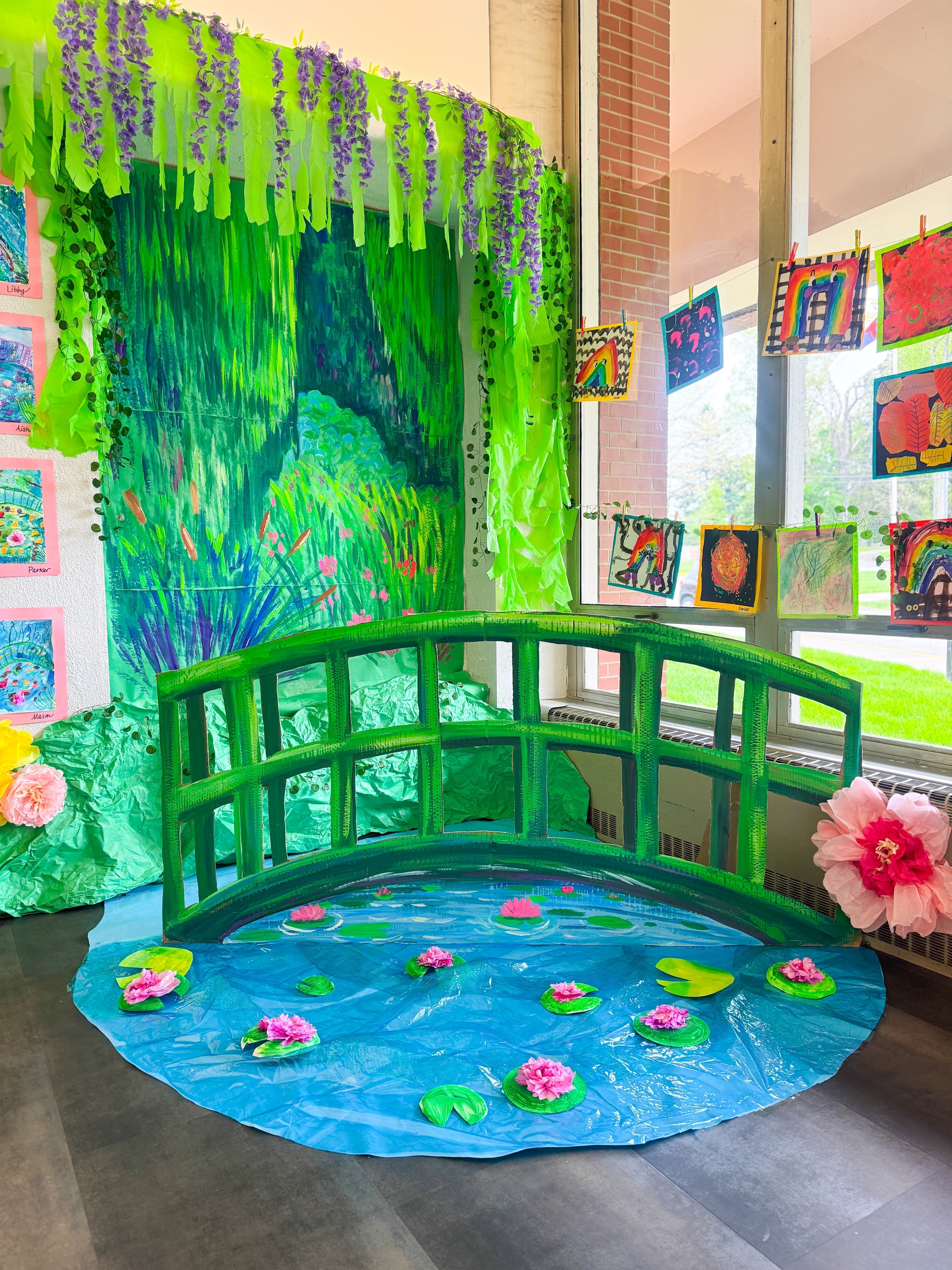
This year, I decided to create a Monet-inspired installation for my kindergarten art show, complete with a Japanese bridge, lily pad pond, and a dreamy garden backdrop inspired by Monet's breathtaking home at Giverny. Yes, it was a bit of a labor of love but I had no idea how much my soul needed to make this! Hearing the kids squeals of delight as they entered this transformed space made my heart just explode with joy!
Let me walk you through exactly how I made it!

The Vision: Bringing Monet's Japanese Bridge to Life
The most recent lesson I taught my kindergarten students was inspired by Monet's famous painting, The Japanese Footbridge (1899). The kids absolutely loved not only creating their own version of this stunning painting, but they loved learning about Monet's work, his home in Giverny where this was painted and that you can actually walk over this iconic bridge and tour his home and gardens yourself! It has always been a dream of mine to tour this property, so I was beyond thrilled to teach my students about it.

When it comes to the art show, I wanted the kids to feel ownership of the art show in a special way, and by making the art show theme something they have learned about and created, I felt like they would be more deeply connected to my vision. The plan was for the kids and their families to feel like they were actually stepping into one of Monet’s paintings... think, lush greens, Layered textures, pops of pink flowers, reflections on water, that soft, immersive, almost magical feeling.
And most importantly… something that would be kid-friendly, budget-friendly, and doable with pretty much only classroom materials (with a few exceptions but I'll share those in a bit!)
Step 1: Painting the Garden Backdrop
I started with a few large sheets of green bulletin board paper and painted a loose, expressive garden scene with tempera paint.

What I focused on:
- Loose brushstrokes for foliage, long loose vertical brush strokes for the willow trees
- Layering different shades and values of greens (light green, yellow-green, dark greens with tints of purple) for depth
- Adding pops of pinks and purples for flowers
- Keeping it impressionistic, not detailed

✨ TIP: Don’t overthink this part. The magic is in the layering and movement, not perfection. I free handed this, but you can always use a projector to at least get an outline of what you want to paint.
Step 2: Creating the Japanese Bridge
I definitely wanted this to be the centerpiece! But initially struggled with how to make it... because I certainly am not a carpenter and don't really know anyone who could just casually "whip up" a wooden bridge for kids to walk over! After scouring facebook marketplace for one last attempt to find a real bridge, I decided to scrap the idea and turn to my tried and true: cardboard. My dear friend Becky mentioned that she had made a cardboard bridge for a Monet display she had made for her art show a few years ago, so I knew it would work! I just had to figure out exactly how I could use cardboard to give the illusion of it being a real bridge.
So- first step: locking down the cardboard. A few month ago we had new closet doors installed at our house, so I made sure to hold only the huge flat cardboard boxes they came in... I wasn't exactly sure what I would use them for at the time, but I do know as an art teacher, you NEVER toss huge boxes that find their way to you.
A note before I break down the process, you can check out this reel I made on how I made this bridge from start to finish over on my Instagram here.
But let's get into it:

- First, using Crayola Premier tempera paint in an lidded ice cube tray , I started with painting the arch shape at the bottom of the bridge across the cardboard.

2. Thickened up the base and painted a matching arch at the top. I used a variety of greens and a large flat brush to get a very "painterly look". Nothing too flat or perfect. Loose Loose Loose with lots of green variety!

3. Painted the Added vertical and then horizontal “railings” and then mixed a darker green/ bluish purple for the railings on the "back" railings of the bridge. Lastly I added some highlights with a light yellow/ green on top of the railings. ✨ Another tip: Use a dry brush for texture .. it gives that Monet-inspired feel instantly.


4. Once the bridge was dry, I used my all time favorite cardboard cutting tool to cut out the top of the bridge and the openings to create that lattice look. I left the bottom area under the bridge untouched to allow me to ensure there would be enough support to the structure when I went to attempt to make it stand.

5. Now time to figure out how to get this bridge to stand up on it's own! Using the leftover cardboard I made two large right triangles with a flap that I hot glued to the back of the bridge on each side of the back. I also glued a few strips of cardboard to reinforced the structure on the back to prevent the bridge from bending or buckling when kids stood behind it for photos.

6. In the area "under" the bridge, I used tempera paint to paint the illusion of the pond, doing my best to match the blue bulletin board paper/ cellophane I was using for the pond. I used my knowledge of perspective and depth to do my own version of Trompe-l'œil (a term for when artists trick the eye in their art) to paint the water getting darker as it went "back" and then painted lily pads that mimics the 3D lily pads I had made for the pond (more on how I made those to come). The lily pads were painted larger in the foreground and then smaller as they went "back" in the pond. Ta da- it's done!
Step 3: Building the Pond
How to add a little magic on a budget.
Materials:
- Blue bulletin board paper from the teacher's supply room
- Blue cellophane roll (a must for water magic! This is the one I used but I really wish I had seen THIS ROLL because it's iridescent and sooo pretty!)
- Wide wire ribbon
- (Optional) twinkle lights

- I rolled out enough paper to fill the corner area where I envisioned the pond going. Secured the paper down with clear packing tape.

2. Using a roll of wire sparkly ribbon that I just so happen to find in the teacher supply room, I cut strips and taped them down in curled loops to help add some height/ dimension to the pond before the layer of cellophane

3. Lastly, I crumpled up the cellophane to add some texture to the look of the water and then placed it on top of the paper and ribbon. Once it was in the right place I secured with tape and then trimmed the outside edge to match the shape of the paper.

Then I added:
- Lily pads (we made these out of painted paper plates and dyed coffee filters! Check out my reel here to see how exactly we made these )
✨ If you want to add more magic then place a layer of battery operated twinkle lights in between the bulletin board paper and the cellophane.
Step 4: Hanging Greenery + Wisteria
To frame the space, I added hanging elements above the backdrop.

What I used:
- Green plastic table cloths cut into strips for vines (I just got mine from the Dollar Tree!)
- Crumpled bulletin board paper for texture
- Faux vines and purple wisteria from Amazon
I layered everything across the top and let it hang down to create that “garden canopy” effect.
✨ Tip: Vary the lengths! That’s what makes it feel natural and not too uniform.
Step 5: Bringing It All Together

Once everything was assembled:
- The bridge sat slightly in front of the pond
- The pond extended outward on the floor
- The backdrop filled the wall behind
- The hanging greenery framed the entire scene
And just like that… it became a full little world 💚
Was this display perfect? Nope. Did I hot glue my fingers at least twice? 1000% yes.
But watching my students walk in and say things like,
“Whoa… it looks like the real painting!” …that made every second worth it.

If you’re on the fence about creating something like this, let this be your sign:
- You don’t need fancy materials
- You don’t need a huge budget
- You just need a vision and a willingness to start
Start simple. Add additional elements if you have time, allow your materials and surroundings to inspire you and go from there!
And most importantly… have fun with it!
If you try something like this in your own space, I would LOVE to see it. Tag me or send me photos! I would sooo love to see it!
Happy creating, friends 🎨✨




1 comment
Your scene is very nice. Thank for a job well done.